July 01, 2026

UN and Lebanon flags © hapelinium, licensed under Shutterstock
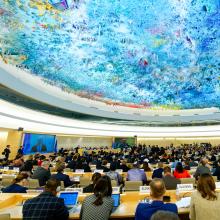
Lebanon appeared before the UN Human Rights Council (HRC) on January 19, 2026, for the fourth cycle of its Universal Periodic Review (UPR). In the lead-up to the review, MENA Rights Group and the Cedar Centre for Legal Studies published a joint report examining Lebanon’s role in facilitating transnational repression. MENA Rights Group and its partners also held a side event in Geneva on the eve of the review, bringing together legal experts and human rights practitioners to present their findings to UN Member States.
On June 18, 2026, Lebanon conveyed to the Council its position on the 286 recommendations it had received, accepting 218, noting 62, and partially accepting and partially noting 6. The UPR was formally adopted on June 30 by the HRC.
Non-refoulement and transnational repression
Lebanon accepted all three recommendations calling on it to uphold the principle of non-refoulement made by Mozambique, the Republic of Korea and the UK. In our shadow report, MRG had recommended that Lebanon systematically assess extradition requests in compliance with this principle, refrain from extraditions that would violate it, and enshrine it in domestic law in line with article 3 of the UN Convention against Torture (UNCAT) and article 7 of the International Covenant on Civil and Political Rights (ICCPR).
Hence, the structural failings of Lebanon’s extradition framework remain unaddressed. Lebanon's Penal Code does not enshrine non-refoulement, and extradition decisions rest overwhelmingly with the executive branch, leaving no meaningful space for independent judicial scrutiny. Lebanese legislation also does not guarantee an effective right of appeal with suspensive effect against extradition orders. Regional cooperation mechanisms compound these gaps: Lebanon relies on the Arab Interior Ministers’ Council (AIMC) to circulate extradition requests, a body that operates without any oversight and whose framework contains no mechanism for individuals to challenge warrants issued against them.
These failures were illustrated concretely by the case of Abdulrahman al-Qaradawi, a Turkish-Egyptian poet extradited to the United Arab Emirates (UAE) in January 2025 on the basis of an AIMC warrant, despite an urgent appeal from UN human rights experts warning of a serious risk of torture and enforced disappearance. Al-Qaradawi remains in in the UAE ever since.
MRG therefore calls on Lebanon to codify non-refoulement in its domestic legislation, guarantee an effective right of appeal with suspensive effect against extradition orders, and suspend extraditions based on AIMC warrants until the Council’s framework is aligned with international human rights standards, so as to ensure the effective implementation of its accepted recommendation to uphold the principle of non-refoulement.
Anti-torture framework
Lebanon accepted several recommendations aimed at strengthening the prevention of torture, operationalising its national preventive mechanism (NPM), and ensuring independent access to all places of detention. It also accepted recommendations by Ghana and Switzerland to bring its anti-torture legislation into line with international standards, as well as Lesotho’s recommendation to ensure accountability for acts of torture and ill-treatment. However, it merely noted, thereby declining to commit to implementation, Germany’s recommendation to amend Act No. 65 to abolish the statute of limitations on torture.
Despite ratifying the UNCAT and adopting the Anti-Torture Law No. 65 in 2017, Lebanon has repeatedly carried these commitments forward from previous UPR cycles without meaningful implementation. The NPM remains largely non-operational and lacks the independence and resources necessary to fulfil its mandate effectively. Rehabilitation services for torture survivors continue to be provided almost exclusively by civil society organisations, with little meaningful support from the State. These shortcomings were highlighted by MRG and its partners during the Geneva side event and remain as pressing today as they were at the time of Lebanon's review.
MRG calls on Lebanon to genuinely operationalise the NPM with adequate resources and independence, amend Law No. 65/2017 to remove the statute of limitations on torture, and ensure that torture risk is systematically assessed in extradition proceedings.
Next steps
Lebanon's accepted commitments cover the right ground, but they build on a track record of limited implementation from previous cycles. MRG therefore calls on Lebanon to translate these acceptances into concrete legislative and institutional reforms before its next review in 2031, beginning with the codification of non-refoulement in domestic law, the suspension of AIMC warrants until their alignment with human rights standards, the genuine operationalisation of the NPM, and the establishment of effective judicial safeguards in extradition proceedings.