August 27, 2026
© Amnesty International
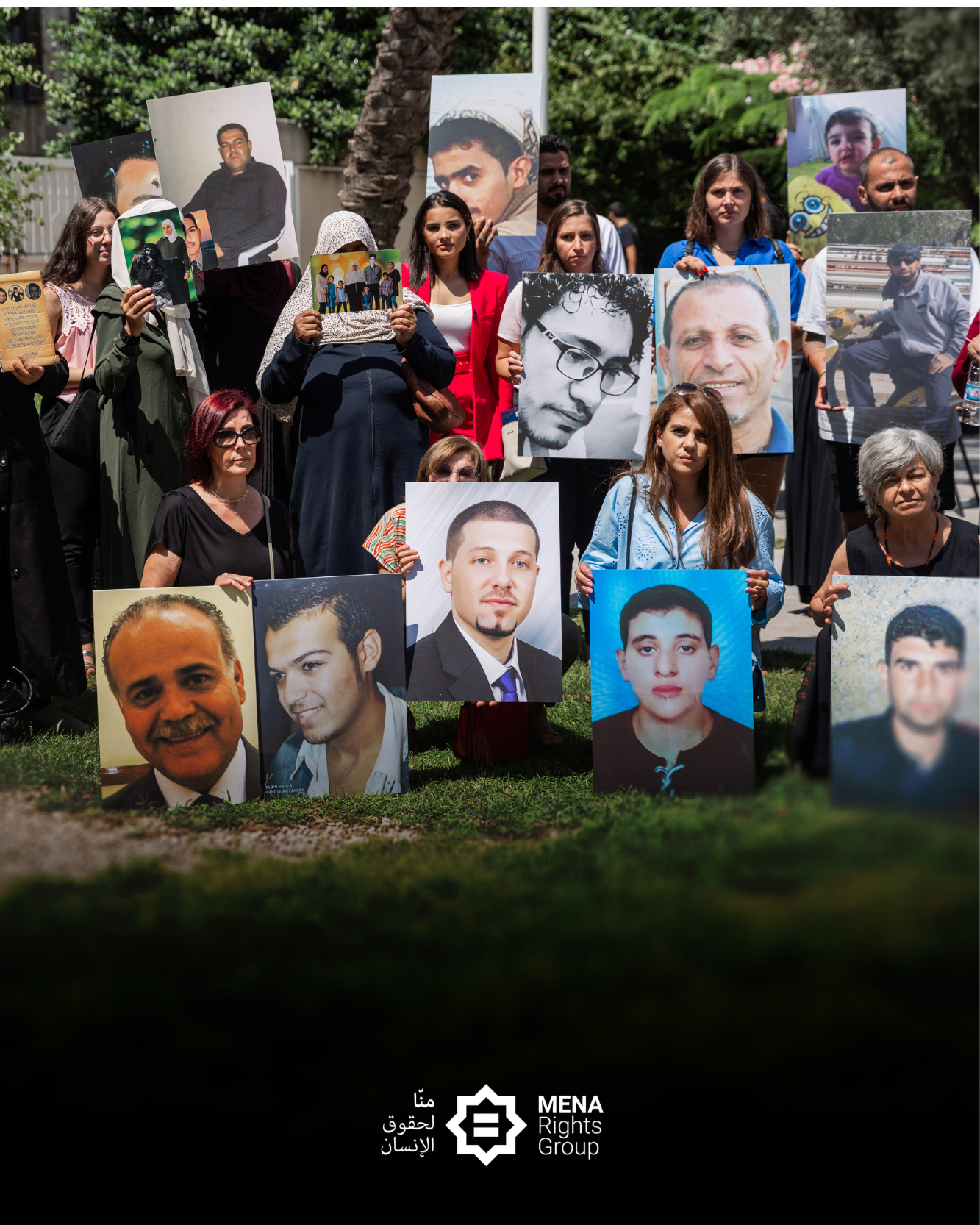
Marking the International Day for the Victims of Enforced Disappearance, we - the families of the missing and the forcibly disappeared in the Middle East and North Africa (MENA), together with associations and human rights organisations working to end the crime of enforced disappearance - are raising a renewed alarm over the scourge of enforced disappearance in our region.
As war, genocide, and authoritarian state practices torment the people of MENA, authorities across the region continue to subject people to enforced disappearance, wage a crackdown on families of the missing and forcibly disappeared, and drag their feet on meeting demands for accountability and reparations, shielding those responsible from justice. Amid this horror, we stand together to fight impunity and expose renewed cycles of a crime we know all too well. We are sending a clear message: the families of the missing and forcibly disappeared will not be silenced, intimidated, or shut down in their pursuit of truth, justice, and reparations.
We were dismayed when on 16 March 2026 Algerian authorities sealed shut the Algiers office of SOS Disappeared. SOS Disappeared, a prominent human rights organisation, was established in 2001 by families of victims calling for accountability for the thousands of people forcibly disappeared in Algeria during the 1990s internal conflict. The police arbitrarily denied the organisation’s founder, Nassera Dutour, who is herself a mother of a victim of enforced disappearance, entry to Algeria in July 2025.
Over the next month, Algerian authorities escalated their crackdown on families of victims of enforced disappearance, arbitrarily arresting at least four relatives of victims, one of whom is still detained. Since 26 March 2026, Algerian authorities have arbitrarily detained activist Rachid Ben Nekhla pending investigations on unfounded terrorism-related charges, based on a recent Facebook post about the enforced disappearance of his father in 1994. In April, Slimane Hamitouche, son of a victim of enforced disappearance and coordinator of the National Coordination of the Families of the Disappeared (CNFD), was sentenced to a suspended six-month prison term and a fine solely for exercising his right to freedom of peaceful assembly and association. Security forces have also been dispersing the gathering of relatives held in Algiers every Wednesday since 1998, citing a lack of authorization and the “closure of the disappeared file”.
The targeting of family associations and relatives of the forcibly disappeared is deplorable. To fear their voices, which have so often been the conscience of post-conflict societies, advocating measures to heal and repair, reflects a sorry state of affairs. The crime of enforced disappearance is a crime under international law that is ongoing until the fate and whereabouts or remains of the person are revealed. It is cruel that families of the disappeared are facing detention, harassment and restrictions on top of the agony and pain of not knowing what happened to their loved ones and the impact the lack of answers has on their ability to mourn.
As well as denouncing this repression of families of the missing and forcibly disappeared, we also mark the International Day for the Victims of Enforced Disappearance with new families having joined the ranks of the families of the missing and forcibly disappeared in recent years. It is painful that authorities continue to commit this abhorrent crime in the MENA region when family associations having waged decades-long struggles not just for truth, justice and reparations for their missing loved ones and themselves, but to ensure that others would forever be spared the agony they have experienced.
Since the beginning of Israel’s genocide in the occupied Gaza Strip, hundreds of Palestinians from Gaza have been forcibly disappeared or gone missing after being taken into Israeli military custody. In the minority of cases where the Israeli military did respond to court petitions filed on behalf of the families of the disappeared, the military claimed there was no indication of their arrest, despite eyewitness accounts to the contrary. Among those forcibly disappeared since 7 October are Palestinian journalists Haitham Abdelwahed and Nidal al-Waheidi, who were last seen on 7 October while filming the aftermath of the 7 October attacks. In Yemen, parties to the conflict have detained and forcibly disappeared people in areas under their control, including journalists, human rights defenders, and humanitarian workers. Yet enforced disappearance is not confined to armed conflict. Across parts of the region, it has become an entrenched tool of repression within criminal justice systems and security apparatuses, used to silence critics, punish dissent, and instill fear.
In countries including Algeria, Egypt, Iran, Libya, the United Arab Emirates, and Saudi Arabia, enforced disappearance has remained a routine tool of repression, with authorities regularly denying detainees contact with their families and lawyers and withholding information about their fate and whereabouts.
Societies in our region, including Syria, Lebanon and Iraq, have been devastated by the use of enforced disappearance, and yet our demands for truth, justice and reparation have not come to fruition. In Syria, after the fall of Bashar al-Assad on 8 December 2024 when detention centres and prisons were opened, we hoped that the families of the tens of thousands of disappeared between 2011 and 2024 would finally reunite with their loved ones. However, most of the disappeared did not emerge, and the majority of families are still waiting for answers about the fate and whereabout of their missing loved ones, prolonging their uncertainty, grief, and suffering, while continuing to campaign for truth, justice and reparations.
On this International Day for the Victims of Enforced Disappearance, we call on governments across the Middle East and North Africa to:
- Immediately end the crime of enforced disappearance and ensure that no one is detained outside the protection of the law.
- Conduct prompt, independent, impartial and effective investigations into all allegations of enforced disappearance and hold all those suspected of criminal responsibility to account in fair trials before ordinary civilian courts and without recourse to capital punishment, regardless of rank or affiliation. Investigations into all cases of missing people and enforced disappearance should be expedited, their findings made public in a transparent manner, and families’ right to know the fate and whereabouts of their loved ones fully guaranteed.
- Reveal the fate and whereabouts of all missing and forcibly disappeared persons, provide families with accurate information, and return the remains of those who have died.
- Accelerate efforts to locate, investigate, and identify mass graves, ensuring the preservation of evidence and the protection of the rights of victims and their families.
- Guarantee victims' rights to truth, justice and full reparations, including restitution, compensation, rehabilitation, satisfaction, and guarantees of non-repetition, and their participation in the development of legislation, policies, and national mechanisms addressing enforced disappearance.
- Protect families of the missing and forcibly disappeared, family associations, human rights defenders, journalists and organisations working on enforced disappearance, and end reprisals, harassment, arbitrary detention and restrictions on their work. They should also have access to appropriate legal, psychological, and social support.
- Criminalize enforced disappearance as a stand-alone offence in domestic law, where this has not yet been done, and bring national legislation into line with international law and standards.
- Ratify, without making any reservation, and fully implement the International Convention for the Protection of All Persons from Enforced Disappearance (ICPPED) and recognize the competence of the Committee on Enforced Disappearances to receive and consider communications from victims or their families and other states parties and also cooperate fully with UN mechanisms addressing enforced disappearance.
- Officially mark and recognize the International Day for the Victims of Enforced Disappearance and publicly acknowledge the suffering of victims and their families.
As families of the disappeared and organisations standing alongside them, we refuse to accept enforced disappearance as a permanent feature of life in our region. Despite intimidation, repression and loss, families have continued to organize, document, advocate and keep the memory of their loved ones alive. The struggle will continue. We will not be silenced, and we will not stop.
Signed,
Abductees' Mothers Association (Yemen)
Act for the Disappeared (Lebanon)
Al-Haq Foundation for Human Rights (Iraq)
Amnesty International
Building Foundation for Training and Development (Iraq)
Caesar Families Association (Syria)
Committee of the Families of the Kidnapped and Disappeared in Lebanon (Lebanon)
Gulf Centre for Human Rights (GCHR)
HuMENA for Human Rights and Civic Engagement
INOVAS
MENA Rights Group
Mesllet Babel Human Rights Network (Iraq)
National Coordination of Families of the Disappeared in Algeria (CNFD)
SOS Disparus (Algeria)
Ta'afi Initiative (Syria)
The Syria Campaign
Truth Tents in Syria